The depreciation alone will make or break your RV investment. Our New vs Used RV Buying Guide can save you thousands.
Most first-time buyers obsess over floor plans and slide-outs while ignoring the single factor that determines whether you build equity or bleed cash. A new RV loses 20-30% of its value the moment you drive it off the lot, while a used one has already absorbed that hit. But that same used rig might hide $15,000 in deferred maintenance behind fresh paint and detailed interiors.
The gap between these two paths widens every month you own the rig. New buyers enjoy warranty coverage and zero-surprise repairs. Used buyers pocket the depreciation savings but gamble on previous owner care. Neither choice is wrong, but one can be catastrophically wrong for your specific situation.
Here’s how to know which one wins for you before you sign anything.
New RVs hit peak price the second the dealer prints your paperwork.
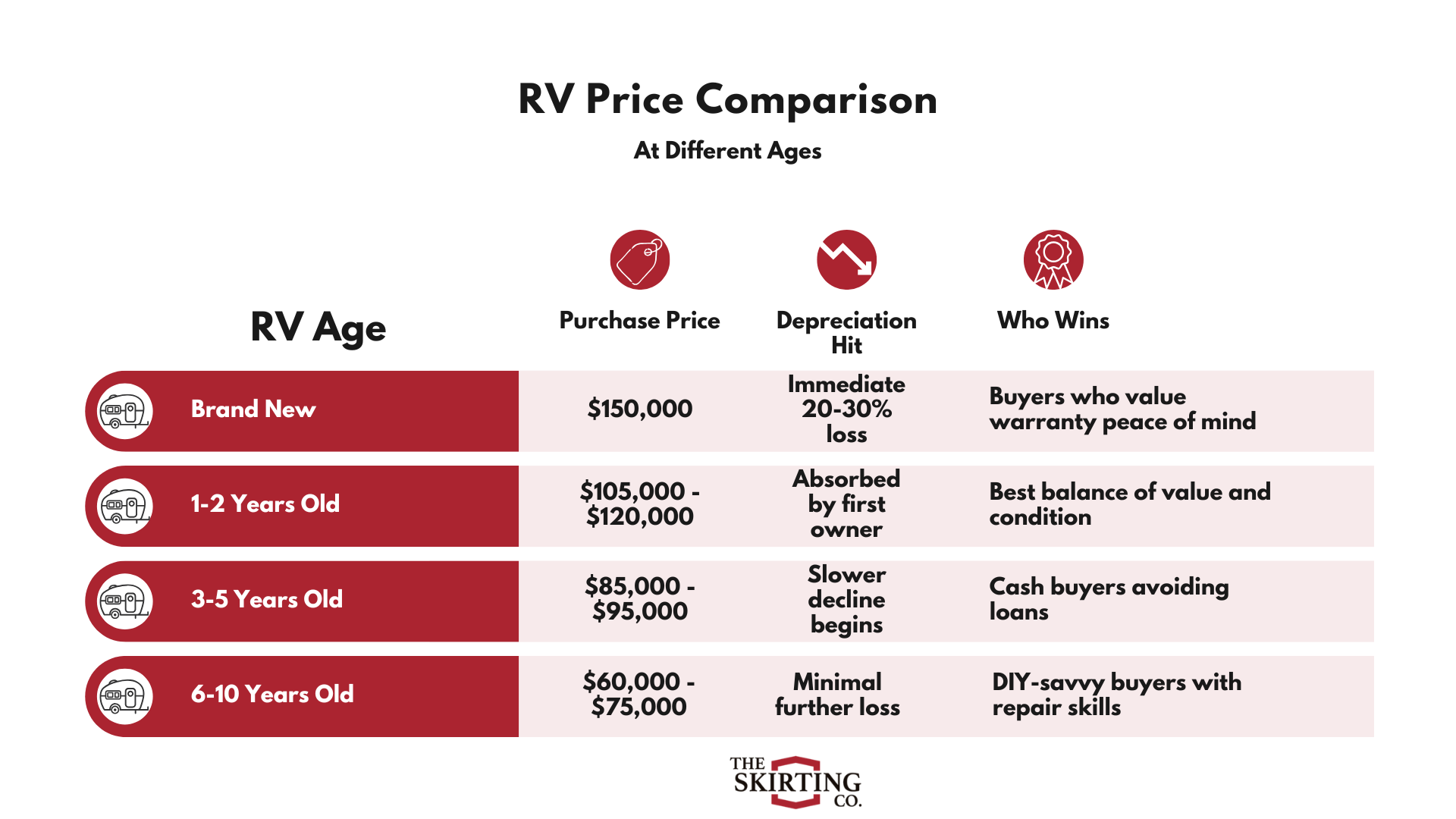
That shiny Class A motorhome listed at $150,000 drops to $105,000 in trade-in value within 12 months. The same rig at three years old? You’re looking at $85,000 to $95,000, and the depreciation curve flattens dramatically after year five. This isn’t a minor detail. It’s the difference between losing $45,000 or gaining $10,000 in equity over your first ownership cycle. Buyers who ignore this math often find themselves underwater on loans, unable to upgrade, and stuck with a rig that no longer fits their needs.
The financing terms shift dramatically too. New RVs qualify for 10-20 year loans at 4-7% interest. Used rigs over five years old? Expect 7-10% rates with shorter terms, and anything over ten years old may require cash or personal loans at even higher rates.
The winner here depends entirely on your financial position. If you can absorb the depreciation hit and want predictable costs, new makes sense. If you’re paying cash or can handle uncertainty, used wins on pure math. But this is just the surface cost. The real financial gap shows up in year two and beyond.
Every used RV is a rolling game of mechanical roulette.
New RVs ship with manufacturer warranties covering 1-3 years on structure, appliances, and drivetrain components. Premium brands extend bumper-to-bumper coverage, and you can add extended service plans that push protection to 5-7 years. That coverage becomes your safety net against $4,000 refrigerator failures, $2,500 slide-out motor replacements, and $8,000 roof delamination repairs. These aren’t rare edge cases. They’re common failures that plague RVs across all brands, and warranty coverage is the only thing standing between you and a credit card meltdown.
Used RVs come with whatever warranty time remains, which often means zero coverage.
The financial swing gets severe fast. A single water leak that goes undetected for six months can cause $12,000 in rot damage. That same issue on a new RV gets caught during dealer service visits and fixed under warranty. On a used rig, you eat the entire bill.
This is where the depreciation savings evaporate. A used buyer who saves $40,000 upfront but spends $15,000 in year-one repairs ends up behind the new buyer who paid full price but had zero surprise costs. Warranty coverage isn’t just peace of mind. It’s a financial firewall that determines whether your RV investment stays predictable or spirals into a money pit. If you lack mechanical skills or an emergency repair fund, new wins this category by a landslide.
Used RVs arrive with invisible damage the seller will never disclose.
The exterior looks flawless because the seller just waxed it. The interior smells clean because they bombed it with odor eliminators. But behind the walls, water damage spreads through studs and insulation. Under the rig, suspension components sit one pothole away from failure. Inside cabinets, mice have chewed wiring that will short out the moment you plug into shore power. These issues don’t show up in test drives or casual walkthroughs, and most private sellers either don’t know about them or actively hide them to close the sale.
New RVs eliminate this minefield entirely. You’re the first owner. No hidden accidents. There is deferred maintenance. No mystery smells that turn out to be black mold. The condition is known, documented, and covered under warranty if defects surface.
The tradeoff is stark. Used buyers trade peace of mind for savings. New buyers trade savings for certainty. If you lack the time or expertise to perform a pre-purchase inspection with a mechanic and RV technician, buying used becomes a coin flip. One bad rig wipes out every dollar you saved by avoiding new pricing. Condition uncertainty is the single biggest risk in the used market, and it’s a risk new buyers never face.
New RVs let you build the rig around your life instead of adapting your life to the rig.
You walk into a dealership and spec out the floor plan, appliance package, and feature set that matches how you actually camp. Need a king bed instead of a queen? Done. Want a residential fridge instead of propane? Standard on most new builds. Prefer a rear living layout with theater seating over a rear bedroom? Manufacturers offer six variations of that exact setup. This level of customization ensures the rig works for you on day one, eliminating the compromises that make used buyers regret their purchase six months in.
Used RVs force you into someone else’s choices.
The previous owner wanted bunk beds for kids. You’re empty nesters who need office space. The floor plan doesn’t flex. You’re stuck with their layout or you pay $10,000+ for custom modifications that rarely add resale value. The appliances, upholstery, cabinetry, and electronics are all locked in. You can replace some items, but major changes like moving slide-outs, reconfiguring bathrooms, or swapping bed sizes require contractor-level work that costs more than the depreciation savings.
The gap widens if you have specific needs. Full-timers need washer/dryer hookups, larger fresh water tanks, and upgraded HVAC. Weekend warriors prioritize toy hauler garages and outdoor kitchens. New builds accommodate both. Used rigs rarely offer the exact combination you need, forcing you into compromise or expensive retrofits. If getting it right the first time matters more than saving money upfront, new customization is the only path that works.
The sticker price tells you nothing about what you’ll actually pay.
Lenders view new and used RVs as completely different risk profiles, and that difference shows up in your monthly payment and total interest paid over the loan term. A new $150,000 RV financed at 5.5% over 15 years costs $1,225 per month and $70,500 in interest. That same rig as a three-year-old used purchase at $95,000 might carry a 7.5% rate over 10 years, resulting in a $1,125 monthly payment and $40,000 in interest. The used rig saves you $100 per month and $30,500 in total interest, but only if you qualify for the shorter term and higher rate.
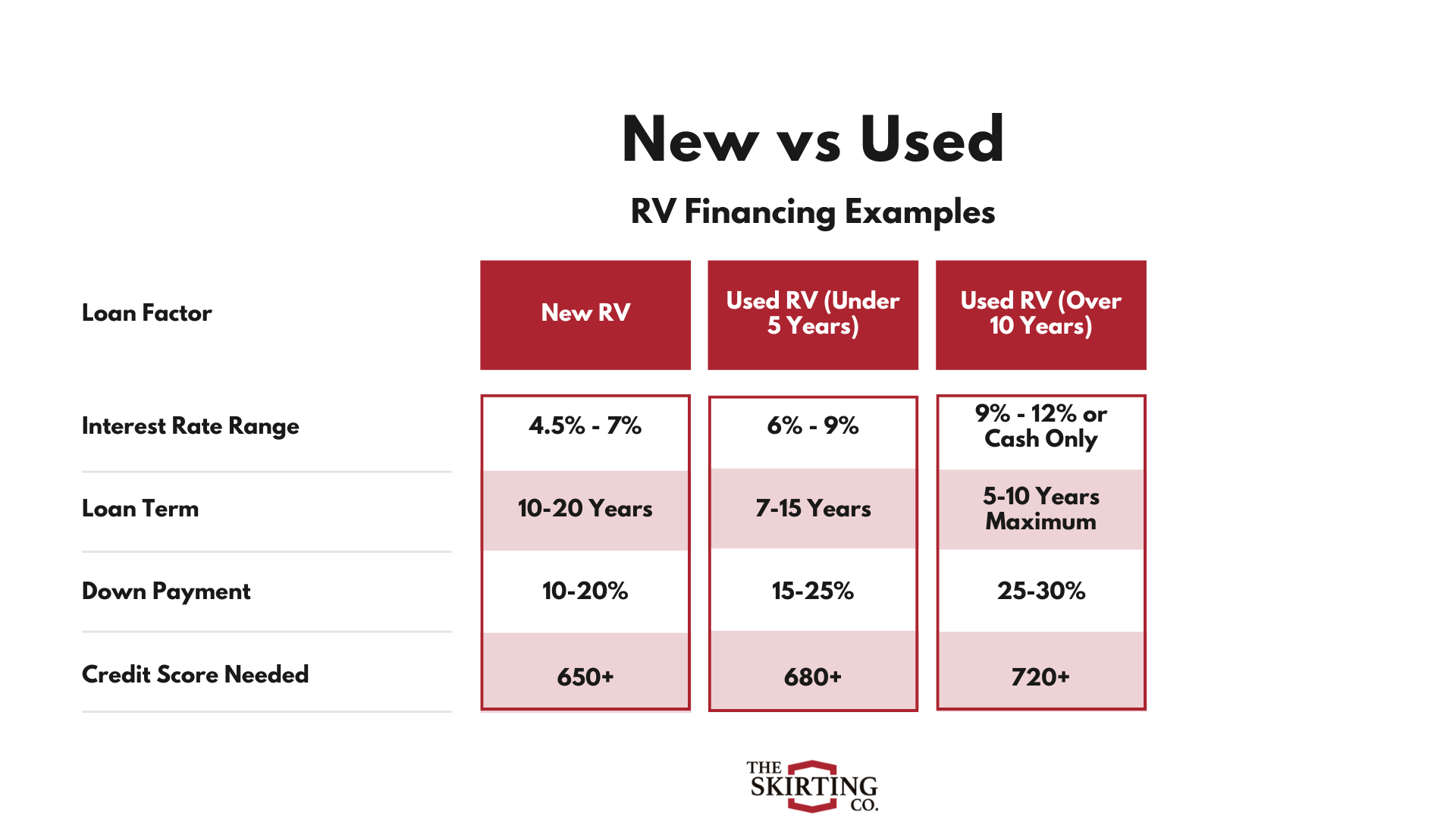
The payment difference shrinks when you factor in the down payment. That used $95,000 rig at 25% down requires $23,750 upfront. The new $150,000 rig at 15% down needs $22,500. Your cash outlay stays nearly identical, but the new buyer gets longer terms and lower rates while the used buyer faces higher monthly obligations on a shorter payoff schedule.
Insurance costs swing the math further. New RVs carry higher premiums because replacement values sit at peak levels. Used rigs cost less to insure, but the gap narrows to $300-$600 annually, barely moving the needle on total cost of ownership. When you map the full financing picture including interest, insurance, and down payment, the used savings often compress to $8,000-$12,000 over the loan term instead of the $40,000+ gap the sticker price suggests. New buyers who secure promotional 0-2.9% rates during sales events can actually beat used buyers on total cost when warranties prevent repair expenses. The financing math is never as simple as sticker price divided by months.
Buying used means you become a detective, mechanic, and contractor all at once.
New RV buyers walk the lot, test floor plans, and sign papers. The dealer preps the rig, performs a walkthrough, and hands over keys. Total time investment: 4-8 hours across two visits. Used RV buyers face an entirely different gauntlet. You schedule pre-purchase inspections with certified RV technicians who charge $300-$600 per rig. Then, someone has to crawl under the frame checking for rust and damage. You run every system, test every appliance, and document every flaw to negotiate price reductions. Maintenance records are check, verification of title history, and confirmation no liens exist. This process repeats for every rig you consider, and most used buyers evaluate 3-5 rigs before finding one that passes inspection.
New RVs skip this entire ordeal. The manufacturer’s quality control and dealer prep replace your inspection needs. Factory defects that slip through get caught under warranty. You invest hours instead of weeks, and your risk exposure drops to near zero.
The effort gap becomes a deal breaker for buyers without mechanical knowledge or time flexibility. Used purchases demand expertise most first-time buyers lack. You either pay a professional inspector for every rig you evaluate, adding $1,500-$2,500 to your search costs, or you gamble on your own assessment and pray nothing expensive breaks post-purchase. New buyers trade money for certainty. Used buyers trade time and stress for savings. If your schedule is tight or your mechanical skills are limited, the used market’s effort tax makes new rigs the only realistic option.
Buy new if you: value predictable costs over upfront savings, want warranty protection against expensive repairs, need specific customization or floor plans, lack mechanical skills or time for inspections, plan to finance long-term with lower interest rates, or intend to keep the rig for 10+ years to ride out depreciation.
Buy used if you: can pay cash or secure competitive rates on older rigs, possess mechanical knowledge or budget for professional inspections, accept repair uncertainty in exchange for 30-50% cost savings, prioritize immediate equity over warranty coverage, or plan to upgrade within 3-5 years before major systems fail.
The decision isn’t about which option is universally better. It’s about which risks you’re equipped to handle. New buyers pay a premium for certainty and customization. Used buyers gamble on condition to capture depreciation savings. Both paths lead to successful RV ownership when matched to the right buyer profile, but choosing the wrong one for your situation creates financial regret that lasts for years.
Most buyers who regret their choice ignored their own risk tolerance, mechanical skills, and financial position. New buyers who stretched their budget beyond comfort end up with payments that kill the joy of RVing. Used buyers who skipped thorough inspections spend more on repairs than they saved upfront. The winning move is brutal honesty about your capabilities and priorities before you ever set foot on a dealer lot.
The right RV isn’t the one that looks best in photos or offers the lowest sticker price. It’s the one that matches your skills, budget, and willingness to handle uncertainty. Nail that match, and you’ll spend the next decade building memories instead of managing regrets.

Hayley and her husband, Chase, lived full-time in their (used) RV while Chase served in the military. They have traveled all over the United States with their 4 kids. Currently, the family is ranching in Montana and they enjoy exploring the great outdoors.